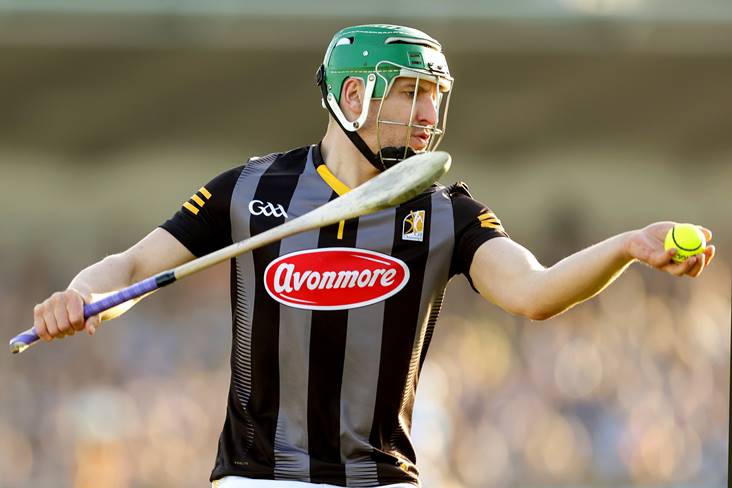
After lucky escapes in 2000 and 2002, relegation finally became a reality for Moate All-Whites last year when they lost to neighbours Ballymore. But corner back Damien Phelan believes it won't be too long before they are operating at senior level again.
For Moate All-Whites, 2004 marked the end of an era. After 43 years in the senior ranks, they were relegated to the intermediate grade last October following a play-off defeat to neighbours Ballymore at Cusack Park.
Despite entering the game as favourites, the All-Whites were decisively beaten on a 1-5 to 0-3 scoreline. It was the third time in four years that they had been involved in a relegation play-off, but this time there was no escape route.
"We had been living dangerously for a few years and I suppose our luck had to run out at some stage," concedes pint-sized corner back and 1995 All-Ireland minor medallist Damien Phelan.
"We beat Rosemount to stay up in 2000 and did the same against Ballynacargy in 2002, but didn't heed those warnings and found ourselves in the same situation again last year. As it transpired, we were beaten by a Ballymore team who wanted to stay up more than we did. They were more up for it."
Moate's performances in recent seasons have been a far cry from the glory years of the 1970s when they won senior championships in 1975, '76 and '78 and were regarded as one of the top club sides in Leinster. They went on to capture the Flanagan Cup again in 1983 and '97, with Ger Heavin inspiring the latter success. However, their fall from grace has been reflected in their failure to progress beyond the group stages of the championship since then.
Phelan, who was a member of the '97 team, attributes the club's decline to a lack of young talent coming through.
"We have paid a heavy price for neglecting our underage section," he laments.
"There is great work being done with the underage now, but it has happened too late for us to stay in the senior ranks. For years, the Carmelite College was a breeding ground for young players but since it closed we have suffered greatly.
"Another reason why I think our underage section suffered was because a lot of the emphasis was placed on the senior team. When you've a successful senior team, the other teams can often lose out and I think that's what happened in our case."
Having lost the services of former county stars Ger Heavin (transferred to St. Mary's, Sligo), John Murray (transferred to Ballycumber) and Kit Gillivan (retired), Moate were facing an uphill battle before the season ever began. Their problems were added to with the late appointment of Ballycumber man Paul Gavin as manager.
Despite their difficulties, Moate gave a good account of themselves against Mullingar Shamrocks in their opening game of the championship in early May. Shamrocks raced into an early 0-3 to 0-0 lead but an Alan Claffey goal left them just a point in arrears at the interval.
Following the changeover, Anthony Malone levelled matters before Brian Morley edged Shamrocks back in front. Points from Jimmy Gillivan and Declan Costello kept Moate in touch but Shamrocks replied with similar scores from Sean Maguire, Darren Moore and Morley to run out 0-10 to 1-4 winners.
A late point from substitute Eric Molloy earned the All-Whites a 2-10 to 0-16 draw with St. Malachy's in their second outing at Kilbeggan. Despite an early goal from Jimmy Gillivan, Moate looked to be in trouble at half-time when they trailed by 1-2 to 0-10.
But producing a much improved performance after the restart, Moate battled back with points from Lar Gillivan, Jimmy Gillivan, Declan Costello, Paul McLoughlin and inspirational full back Kevin Flanagan before substitute Nigel Adamson brought them level with a well-taken goal. When Alan Mangan restored St. Malachy's lead with time almost up, they looked like holding on but Molloy - who is better known for his exploits on the soccer pitch - saved the day for the All-Whites with his last-gasp equalizer.
In 2003, Moate consolidated their senior status with a shock victory over Garrycastle but there was to be no repeat of that result when the sides met at Pairc Chiarain at the end of August. Like Moate, Garrycastle were seeking their first win of the campaign after only managing to take a point from their opening two matches.
Garrycastle were quickly into their stride and had established a 2-6 to 0-3 lead before unanswered points from Costello, Adamson, Jimmy Gillivan and Paul McLoughlin reduced the deficit to four at half-time. It remained close in the second half until a third goal from Dessie Dolan propelled Garrycastle to a somewhat flattering 3-14 to 0-13 victory.
Despite producing another gutsy performance, Moate suffered their third defeat when they succumbed to Tyrrellspass by 1-10 to 3-9 at Tang. Helped by goals from John Corcoran and David Glennon, Tyrrellspass led by 2-6 to 0-5 at the interval. On the restart, Moate cut the gap with unanswered points from Flanagan and Lar Gillivan (two), only for Corcoran to reply with his second goal.
The introduction of Eric Molloy sparked a late Moate revival which saw him land two points and set up a goal for Jimmy Gillivan. But Tyrrellspass had already done enough to secure the win.
Moate's place in the relegation play-off was confirmed following another reversal at the hands of Tubberclair in their final group match. Tubberclair, who were also battling to preserve their senior status, made all the early running and were six points to the good at half-time thanks to a John Reid goal.
In the second half, Moate battled back with points from Lar Gillivan and substitute John Deehan to leave four, 0-6 to 1-7, between the sides with three minutes remaining. But that was as close as they came as a late goal from Francis Spollen and an even later point from David Cassells sealed a 2-8 to 0-6 victory for the Glasson men.
Everything now hinged on the play-off with Ballymore which took place at Cusack Park on October 16. Moate, with their great tradition, entered the contest as favourites but Ballymore hadn't read the script and, after a tough battle, emerged as five-point winners.
Despite playing against the wind in the first half, Ballymore took the game to their illustrious neighbours and never looked back after Anthony Kearney scored the only goal in the 22nd minute. That score helped the green and golds to a 1-3 to 0-2 lead at the interval and they made sure of victory in the second half with further scores from Kearney and Derek Molloy.
"Even though it had been coming, we were still devastated to be relegated," Phelan recalls.
"It was always going to be difficult to survive with Ger, Kit and John no longer involved. On top of that, Niall Mackey missed a lot of the year with an ankle injury and Kevin Deehan was working in England. We just couldn't cope with those losses."
Further evidence of Moate's underage revival was provided when the under 16 team reached the club 2 championship decider which they lost narrowly (1-11 to 2-11) to St. Michael's. Many of the same players also featured for St. Brigid's in their under 16 'premier' championship final defeat to Inny Gaels.
"It's going to take time for the young lads to come through but I'm optimistic about the future. The intermediate championship is the ideal place to blood these youngsters," the 1995 All-Ireland minor hero says.
Phelan isn't sure if Moate will be able to repeat St. Mary's feat of winning the intermediate championship at their first attempt, but he certainly isn't without hope.
"Eamon Mahon, who is a former Offaly selector, is back in charge of us this year and so far things have been going very well. We're a team that's very much in transition at the moment and it will be a big ask to win the intermediate championship in our first year down.
"But we intend giving it a good lash and I'm sure we won't be too far off the mark. Another priority of ours is to get back up into Division 1 after failing to do so last year," he concludes.
The Moate All-Whites team which contested the under 16 club 2 championship final was: Eoin Minnock; Michael Eagney, Eoghan Dalton, James Keneghan; Patrick O'Flaherty, Brendan Arigho, Damien Keneghan; Shane Thornton, Shane Kelly; Mark Ennis, Conor Hynds, David Evans; Patrick Sammon, Thomas Duffy, James Sammon.
Sean Heavin - a Moate footballing legend
During a successful playing career which spanned four decades, Sean Heavin gave everything for club and county. Indeed, many believe he was one of the greatest centre backs ever produced by this county.
It's a Wednesday evening in early May and Sean Heavin is reminiscing about old times. Westmeath are playing Galway in a challenge match on the same evening as part of their championship preparations and, unusually for Sean, he isn't at it.
Between 1997 and 2003, Westmeath football was Sean's life. During that time, he served firstly as an under 21 and then as a senior selector under Luke Dempsey. Rarely did a day pass when he didn't have some matter to attend to or some place to go, all in the best interests of his beloved county.
"It was strange last year not to be involved," the former Moate and Westmeath star says.
"I first got involved as an under 21 selector in 1997 when we ended up losing the Leinster final to Meath. We came back two years later and won the All-Ireland and retained the Leinster title the following year before losing to Limerick in the All-Ireland semi-final.
"After that, I moved up to the senior team along with Luke and we were joined on the management team by Jack Cooney and Ollie Keating. We won the National League Division 2 title at the first time of asking and later went on to reach the All-Ireland quarter-final where we were unlucky to lose to Meath after a replay. We won the Division 2 title again in 2003, but unfortunately we weren't able to improve on 2001 as far as the championship was concerned," he adds.
During Sean's three years as a senior selector, Westmeath's goal had always been to win the Leinster championship. When that finally happened last year, Sean was just a regular spectator, having no involvement with the team. However, he still took immense delight from what had been a long-held dream of his, and every other Westmeath supporter for that matter.
"I was thrilled, it was great to see it happen. A lot of people were probably thinking that I was feeling a bit envious towards the whole thing, but that couldn't be any further from the truth.
"While it is a big regret of mine that we didn't a Leinster title during my time as a selector - I still wonder what would have happened if Dessie Dolan had scored that free against Meath in 2003 - I was part of a management team that had three years at it and that is long enough for anyone.
"Paidi O Se came in with a new management and, fair dues to him, he achieved something that had never been achieved before by a Westmeath manager. Paidi definitely brought something extra to the set-up. When he played for Kerry and later managed them, the aim was always to win an All-Ireland. Until recently, Westmeath were happy to win two rounds of the championship. His mindset was completely different."
Heavin has many happy memories from his seven-year involvement as a county selector and regards the 2001 All-Ireland qualifier win over Mayo as his highlight.
"While the All-Ireland under 21 victory was great, the best day of the lot for me was when we beat Mayo in Hyde Park. It was an incredible game and I never experienced an atmosphere quite like it. Even though I was down on the sideline, it felt like the crowd was breathing down your neck," recalls Sean, who memorably punched the ball into the crowd (denying Mayo manager Pat Holmes possession in the process!) as the Lake County clung onto a one-point advantage in the dying moments of extra-time.
Sean's first involvement with Westmeath was as a minor in 1968. He graduated to the senior team a year later and was an inspiring figure at centre back for well over a decade.
Unfortunately for Heavin, though, his playing career coincided with a particularly barren period for the county. "We didn't even win an O'Byrne Cup," he ruefully reflects.
"Every year, we had high hopes of doing well in the championship, but more often than not we were left disappointed. I played under several different managers, but apart from the odd first round win, we had nothing to cheer about."
By contrast, Sean enjoyed a hugely successful club career and was part of arguably the greatest team ever to come out of Moate. He made his senior debut for the All-Whites as a raw 17-year-old in 1967 and played in his first county final two years later when Moate succumbed to The Downs. Moate also reached the finals of 1970 and '71, but lost to The Downs and Athlone respectively.
The breakthrough finally came in 1975 when Moate beat The Downs to gain revenge for the defeats of '69 and '70. They retained the Flanagan Cup in '76 after another win over The Downs, this time after a replay.
In 1977, Moate reached the final again, only to be defeated by Athlone. They faded from the limelight for a few years before coming back in 1983 to defeat a St. Malachy's team that was appearing in their third consecutive decider.
Throughout all of those years, Heavin was an ever-present at centre back and actually played on until 1992 when he finally brought the curtain down on his playing career.
So what was the secret to his longevity? "I didn't drink or smoke so that obviously stood to me. I was a strong, physical player and the fact that I never suffered a serious injury enabled me to keep going longer than most," he explains.
Sean's memories of Moate's glory years are vivid: "From the time I first came on the scene, we had a physically strong team, but I suppose we didn't add flair to it until the mid-1970s when the players from the successful Carmelite College teams started to filter through.
"We lost the 1969, '70 and '71 finals because we didn't have enough scoring forwards. Most of the scoring was left to our two midfielders, Danny Regan and John McKenna.
"When we won the championships in 1975 and '76, we had good scoring forwards like Eamonn Coughlan and Aidan O'Halloran. The late Kieran Claffey was also a great target man to have playing at full forward and he could also do a job for you at midfield if needed."
Like all Moate supporters, Sean has been saddened by the club's fall from grace and feels that it could be several years before the glory days are revived.
"I've no doubt that Moate will rise again, but it will take a lot of time and patience. It was sad to see them being relegated last year but it had been on the cards for a few years. Ger Heavin (who isn't related to Sean) was a great scoring forward, but when he left the club, there was nobody to fill the void. We basically paid the price for neglecting our underage structure.
"We've a very young team at the moment and their first task will be to win the intermediate championship. Realistically speaking, it could take five years for Moate to be a competitive senior club again."
A former vice-chairman of the Westmeath football board, Heavin remains deeply involved in the GAA. He is treasurer of both the South Westmeath FAS GAA scheme and the Moate All-Whites lotto committee, and is also involved in delivering the Comhairle Club Planning and Development programme to clubs in Westmeath and Offaly.
"Most of my time is now taken up with the planning and development programme which is overseen by Billy Flanagan, the county board's development officer. The aim of this three-year programme is to get more people involved in clubs and to spread the workload around.
"What you find in a lot of clubs is the workload falling heavily on the chairman and secretary. What we're trying to do is to get others involved and get people into jobs that best suit them. Someone with a good business brain can be a big asset to a club. Clubs must be able to plan ahead and have the right structures at this day and age," the Moate legend concludes.