The Cavan Connection
September 20, 2013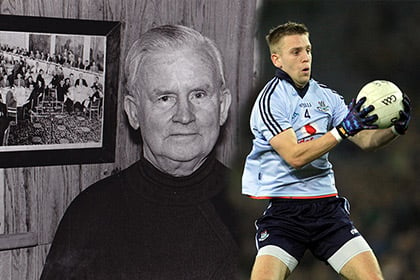
Simon Deignan and Johnny Cooper
Johnny is the grandson of Simon's brother Brendan, who also played for Cavan.
As to the life story of Simon Deignan ... what a read. Best described by Eamonn Gaffney in the Cavan GAA Yearbook Breffni Blue 2007.
The late Simon Deignan
The death occurred at the Bon Secours Hospital, Glasnevin of Mr Simon Deignan, Glasnevin, and a native of Mullagh. Aged 84, he was holder of four All-Ireland medals with Cavan, a minor in 1937 and three All-Ireland senior medals in 1947, '48 and 1952, as well as three losers medals in 1943, '45 and '49. He featured in 12 All-Ireland finals and first played for the senior team in 1940. He was still playing up to 1953. He was also a noted referee and among the big games in which he took charge was the 1958 All-Ireland final in which Dublin defeated Derry.
Deignan was, in fact, one of an elite group who won an All-Ireland championship medal and later refereed All-Ireland finals.
It was in the glorious forties and early fifties that the Cavan team which included Simon Deignan made its name. After Cavan had dominated much of the thirties, the Breffni County came back into the limelight when the senior team appeared in the 1943 All-Ireland senior final and there followed a period of team building during which the older generation of players gradually eased themselves into history and were replaced by players like Deignan. In fact, when Cavan retained the All-Ireland minor title in 1938, Deignan, who was playing his club football with Mullagh, was included at left-half back on a team which sported Willie Doonan, Barney Cully and Paddy Conaty.
In the 1940s Ulster became a force in the Railway Cup and won the title for the first time in 1942, beating Munster in the final. Deignan was selected at full-forward in a team which included seven Cavan players and was captained by John Joe O'Reilly. They retained the title the following year with Deignan lining out at full-forward.
Cavan got through in Ulster in 1943 and faced Cork in the All-Ireland semi-final with a team trained by Sgt O'Reilly and Willie Young in Cherrybank House, the home of Pol McSeain in the heart of Cornafean. After seeing off the Rebels, Cavan faced up to Roscommon in the All-Ireland final. The game ended in a draw and for the replay Deignan was switched to centre-field to partner TP O'Reilly. Roscommon won with a late point from Felim Murray and Cavan finished with fourteen men when Joe Stafford was sent off. Cavan had argued that Murray was standing in the square and this evoked a melee in the final seconds the aftermath of which was that a number of Cavan players were suspended.
Simon was on the team that was defeated by Cork in the 1945 final. The absence of Mick Higgins, injured in training, was a major blow and a goal from Deignan just before half-time which was flagged but was disallowed by referee John Dunne all combined to frustrate the Breffni side.
Cavan still dominated football during the early forties until 1946 when Antrim caused a surprise and Cavan lost the title.
However, history was in the making the following year when Simon was a member of the team which defeated Kerry in the 1947 final in the Polo Grounds, New York. He played at left-half back alongside John Joe O'Reilly and Johnny Wilson. He was also in the team which retained the title in 1948.
There are only two survivors remaining from the 1947 final team, Mick Higgins and John Wilson.
Simon's last appearance in a championship final was in 1949 when Cavan lost to Meath and it came during a period when the Royal County took over the mantle from their near neighbours and dominated the All-Ireland championship. Cavan won the national league title in 1950 but lost to New York in the final proper and it was Deignan's last appearance with the Breffni county.
As to why Cavan didn't add to their All-Ireland titles, Deignan said that John Joe O'Reilly had commented to him before he died that Cavan should have won all the All-Irelands from 1947 to 1952. "John Joe's point was that it was essentially the same team that won for Cavan in 1952 and there could not have been any marked deterioration in 1949, '50 and '51."
While still playing county football, Deignan took up refereeing and amazingly was in charge of the 1947 Munster final between Cork and Kerry played in Cork. In that game he awarded a penalty to Cork and Kerry protested the decision. Simultaneously there was a break in the play as an injured player was receiving attention.
The great Kerry player Joe Koehane recalled "I had one foot on the ball as I argued my point with Simon. All the time I was pressing the ball into the muddy pitch. Jim Ahern (later Fr Ahern) took the kick but he stopped it and it trickled into Danno O'Keeffe."
Deignan then played for Cavan against Kerry in the All-Ireland final of that year. His refereeing saw him take control of two minor finals and All-Ireland senior finals in 1950, '54 and '58, the latter between Dublin and Derry which Dublin won.
Deignan was a founder member of the Referees' Association and also a key figure in the growth and development of the Erin's Isle club in Dublin. Following his retirement he was a selector with the Cavan team in the mid-fifties and was involved when Cavan lost to Kerry in the All-Ireland semi-final replay in 1955.
Simon was involved in controversy at the 1967 Cavan GAA Convention held in the Courthouse, Cavan. When the election of the central council delegate came up for decision between Tom Maguire (outgoing) and Simon, the then chairman TP O'Reilly, a former playing colleague of Deignan's, ruled that he was not eligible to stand as the central council had made a ruling debarring anyone from representing their county if they had affiliations with another county. (Deignan's was then treasurer of Erin's Isle club in Finglas). Mr Deignan told the convention he was sorry that after twenty years associated with Cavan he should be ruled out of order. This rule had been brought in since the previous convention. "We have to agree with it. If I had been elected today I was prepared to release myself from my club in Dublin and to assist Mullagh. I sincerely regret that after all these years with Cavan that I have been ruled out of order as a Cavan man. I must withdraw on that note," Mr Deignan then left the convention.
In a letter to the Editor of the Anglo-Celt in the issue of January 5th, 1968 Mr Deignan said the convention had been a milestone in his career that he was not likely to forget. "If I am to judge by the number of letters and telephone enquires received, the Gaels of Cavan are deserving of further explanation of the events of this day insofar as they affected myself personally.
"My early exit from convention was forced upon me by the chairman when he ruled my nomination to central council out of order. My exit was my protest against unfair and unwarranted decision from the chair.
"The ruling of the chair referred to rule 17 OG which states that a member shall not play for more than one club - and to a recent ruling of the President GAA: "The general principle (rule 17) that a member shall not play for more than one club of the same kind should extend to regulate non-playing membership.
"When a non-playing member of a club (A) joins a similar club (B), he automatically cancels his membership of club. (A) A non-playing member who leaves his home county or home parish (rule 18) may retain his membership of the club he has left, but, if he becomes a member of a similar club in the new county or parish, his former membership is automatically cancelled. He is not eligible to act as an official or representative of his former club or county.
"I contend however that in accordance with rule 18 that I have the right to decide to which club I should show my allegiance, I have the right to declare my allegiance to my home club in county Cavan if I so desire. This declaration is now an obligation upon an elected non-resident representative to central council.
"The chairman's ruling denied to me a freedom of choice in this case and therefore, in my opinion, he gave an unjust and harsh decision.
"I believe it to be unjust to be denied this choice of declaration. I am 30 years associated with Cavan as a player and potential administrator and who is better equipped than the county's longest-serving secretary (Hughie Smyth) to show proof of this service. He understands that for the majority of those years I have signed on the dotted line to declare for my home county and I trust that in all those years I did not prove wanting on or off the field of play.
"I gave this declaration unselfishly and was proud to be associated with such great men as Big Tom O'Reilly, Tony Tighe, Mick Higgins, Joe Stafford, John Joe O'Reilly and PJ Duke and a host of the county's players who willingly played in the true spirit of the game for the honour and glory of the Blue of Breffni.
"Alas, the end of an era had been forced upon me. Naturally, I am disappointed that I should have been so unceremoniously dismissed from the GAA scene in Breffni".
Simon was a member of the Irish army in the forties holding the rank of Lieutenant and was based in Limerick and Athlone among other postings.
He spent most of the remainder of his life in Dublin where he was involved in the auctioneering business up to the early seventies in Finglas and later had his own news agency. There were originally eleven in his family. Among those who predeceased him were his brothers Fr Jim who played for Cavan and was a sub on the '47 team and Brendan who also donned the blue jersey and was a member of the 1955 All-Ireland semi-final team which lost to Kerry after a replay.
Son of the late Alfie and May Deignan who ran a drapery and grocery shop in Mullagh, the family moved to Dublin in 1945 where they purchased a business in Queen's Street. He was predeceased by his wife Teresa and is survived by two sons, Colm and Jim and daughters, Barbara, Yvonne, Catherine, Phillipa and Stephanie.
The funeral took place from the Church of Our Mother of Divine Grace, Ballygall Road East to Dardistow cemetery. The attendance included survivors of the famous Cavan All-Ireland winning teams of the forties and fifties.
In addition, we carry the interview with Simon in Hogan Stand magazine from 2000
Mullagh and Cavans Simon Deignan
April 2000
The days when Cavan senior teams dominated the world of Gaelic football are, sadly, long since gone. Reminding one of the times when the Breffni Blues were national kingpins can be cathartic though as Kevin Carney discovered in talking to former star Simon Deignan.
Simon Deignan speaks about Gaelic football with the same degree of passion and conviction that typified the way he played the game as a star player from an era way back yonder.
At his peak during the forties, Deignan was a player of few equals in Cavan and his All-Ireland Championship and National League medals speak volumes for his ability to contribute to a fantastic Breffni Blues team effort in pressure cooker-type affairs.
They're not rearing men like Simon Deignan in Cavan these days; havent really been either for the guts of thirty years and mores the pity.
Based in Dublin since the mid-forties, the Mullagh native was a hero among heroes back in the countys glory years of 1947, 48 and 52 when the Sam Maguire was coveted and scooped in a whirlwind, romantic period for the border county.
A versatile player who, some argue, would be equally at home in the modern game, Simon first captured the publics imagination in his native Cavan when he lined out at left-half back on the Cavan minor team which won the All-Ireland title in 1938.
It was the mans versatility however as much as his innate ability to play the native game which made him an obvious star in the making.
"I played in every position at various levels during my time with Cavan but Id have to say that a midfield spot was my preferred position - I think my game was suited more to lining out in the middle because I always considered myself to be pretty fit.
As it happened, I only reverted to the backline when I got injured during a McKenna Cup final and it was suggested to me by John Joe (OReilly) that I switch with him and take up the left half back position during the match," Simon explains.
Indeed, as a qualified P.T. instructor in the army, the flying Mullagh ace was also blessed with - in today's football parlance - a great engine and it was hardly surprising that 47 team-manager Hughie O'Reilly should turn to Deignan in seeking to get his panel of players in tip-top physical shape.
Deignan the trainer invariably took a back seat to Deignan the player - at least in the eyes of the watching public in Cavan - but one shouldnt underestimate the part the army man from Mullagh played in getting Cavan into the shape of champions.
Deignan's ability to combine the roles of player and trainer was all the more commendable given that he was under a certain amount of pressure at all times to justify his place among a breed of defenders who, at that juncture, were rated the best crew in the country during the late forties.
The Mullagh maestro was a determined, committed and totally disciplined player and cycling from his Curragh base to Breffni Park for a match (a round trip of 120 mile-plus) wasnt unusual for him.
His exemplary level of self-discipline (a two year course undertaken to become a commissioned ranking officer reflected as much) was something which also stood to him as a referee for his career as a whistler took him right to the very top and saw him referee two All-Ireland senior finals.
Simon's refereeing career began in 1943 while he was stationed in Croom, Co. Limerick and, initially, he found himself refereeing Limerick county championship matches, including finals.
"It wasn't that long before I was refereeing inter-county matches and I remember one of the matches that stands out for me was a Munster Championshp final involving Cork and Kerry at the Mardyke Stadium. The funny thing was that I was on the Cavan team due to meet the winners of that match in that years All-Ireland semi-final!"
Simon admits that his time in Limerick was very enjoyable. Because of his commitment to the army, he seldom played for his native Mullagh and, instead, was prone to organising teams made up of players from the various barracks in which he was stationed.
In this respect, he was pleased to win a Limerick Senior Championship medal with Croom Barracks. He also figured in a Kerry county decider with Boherbee but sadly lost out to a Dinny Lyne -inspired Killarney side.
If the young Keohane was an inspiration to the young, aspirational men from the Kingdom, the likes of Donal Morgan from Cross and neighbour Mattie Gilsenan, captain of Meath, were similarily iconic for Simon as a gasun.
It's not that anyone of a young age back in the thirties needed much inspiration to play Gaelic football because there was simply nothing else to do with your time. Gaelic football was all there was. It really was a religion back then, Simon confirms.
Born and reared in Mullagh, Simon will, one supposes, always be remembered as one of the lads of 47 such is the impact that win in New York made on the psyche of your commoner-garden football fan in Cavan at that time.
Of the things he remembers from the whole Big Apple package, Simon recalls how very few of the panel who flew across the Atlantic were keen on the flight - himself included.
Furthermore, he has a vivid memory of the heat and humidity which almost smothered their bid to play decent football but failed miserably, as it transpired.
"I thought it was a great game of football, one of the best Id been involved in over the course of my career.
We made a great comeback after being eight points behind at one stage. It was a great team performance and winning the All-Ireland that year was certainly the highlight of my career," adds Simon, an auctioneer by trade, who has been ensconced in Glasnevin for the last 40-odd years and who runs a thriving bookshop in Finglas.
Currently a trustee of the Erins Isle club and formerly its chairman, secretary and treasurer, Simon, interestingly isnt exactly in love with the modern game of Gaelic football.
"There's far too much of the short-passing game for my liking. I remember Hughie Reilly telling us that one decent kick of the ball was worth more than 40 hand passes and he was right."
Cavan threw away the chance of getting into the All-Ireland final in 97 because of an over-emphasis on this short-passing business.
"I nearly got a heart-attack watching them play around with the ball along the half-back line and then playing it back to the goalkeeper. It was desperate to see them throw away that match."
Very much still in love with everything that pertains to his native county, Simon was, it times past, a long-time Chairman of the Cavan Association in Dublin. He was foremost in the Associations successful efforts at raising substantial amount of money for charity as well, of course, as seeing to it that all Cavan people were welcomed to Dublin however short or long their stay in the capital.
Still hurting from Cavans disappointing All-Ireland semi-final defeat in 97, Simon hopes to be able to make the relatively short track back down Jones Road in support of the Breffni Blues sooner rather than later. Tweet